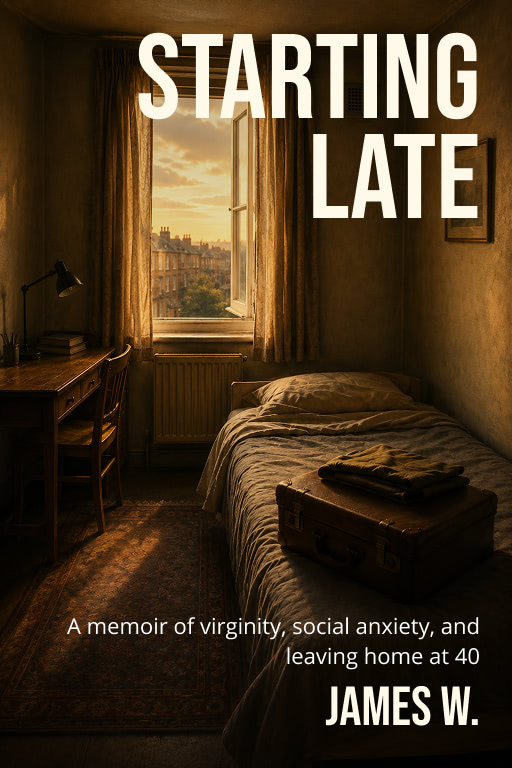
A Note to the Man Still in the Room.
I know what your browser history looks like at 2am.
Not the specific searches — those are yours and I have no interest in them. But the shape of them. The thing you are looking for at that hour, in private, that you would not type into a search engine at any other time of day. The confirmation that you are not the only one. The evidence that someone else has been where you are and that where you are is not where you will always be.
I was looking for the same thing for a long time and couldn’t find it. So I wrote it instead.
This book is about the life I almost missed. The version of the life that was available to me but that I spent nearly two decades not living, for reasons that accumulated so gradually and felt so reasonable at each individual stage that by the time I was in my mid-thirties I had stopped experiencing them as reasons and started experiencing them as facts. The facts were: I was not the kind of person relationships happened to. The window had probably closed. The internal monologue that had been running since I was a teenager was not a monologue — it was just the truth, delivered from the inside.
None of that was true. All of it felt true. The gap between those two things is what this book is about.
I am going to tell you some things about myself that I have never told most people who know me. I was a virgin until I was forty. I lived with my parents until the same age, not because I was forced to but because the combination of social anxiety and circumstance and avoidance had produced an arrangement that was too comfortable to dismantle and too isolating to sustain, and I sustained it anyway. I used porn daily for the better part of twenty years and discovered, in my first sexual experience at forty, what that had done to my brain’s ability to respond to the real thing. I stayed in my first relationship for months after I knew it was wrong because the fear of going back to nothing was stronger than the evidence that the something I was in was damaging us both.
I am telling you these things not because confession is the point but because specificity is. The vague version of this story — man overcomes adversity, finds himself, builds a better life — is useless to the person reading this at 2am in the bedroom at their parents’ house, because the vague version has no resemblance to what that person’s actual life looks like. The specific version might. And the specific version is the only one I can honestly offer.
A word on what this book is not.
It is not a self-help programme. There is no system here, no set of steps to follow, no framework for becoming a better or more attractive or more successful version of yourself. If that is what you are looking for there is no shortage of people selling it, and I am not one of them.
It is not an argument for moving abroad. The specific geography of my story — another country, a city that suited me in ways my own country didn’t — is mine and is not a prescription. The principle behind it is transferable. The destination is not.
It is not a takedown of men who are isolated and struggling. I was one of those men for a long time and I have no interest in looking back at that period of my life with contempt. The internet has no shortage of contempt for men in that position, dressed up as tough love or red-pilled realism or any number of other framings that make the person delivering the contempt feel clear-eyed while offering the person receiving it nothing useful. This book is not that.
It is not a success story, in the sense that success stories imply a destination that has been reached and secured. I am single now. The second relationship, the good one, the one that proved the thing I most needed to prove, ended through adult circumstance rather than failure and I grieved it and carried on. That carrying on is not a setback in the narrative — it is the point. I am not writing from the position of someone who has arrived. I am writing from the position of someone who found out, later than most and earlier than never, that he was capable of arriving.
If you are reading this from inside a life that feels like it has no exit — the room, the routine, the quiet accumulation of years that are passing faster than you expected and leaving less behind than you hoped — then I want to tell you the one thing I most needed to hear and couldn’t find:
The internal monologue is lying to you.
Not about everything. Some of what it tells you is accurate and worth attending to. But the conclusion it keeps delivering — that the window has closed, that this is simply who you are, that the life other people have is not the life available to you — that part is not the truth. It is a story built from the wrong evidence, in the wrong environment, about a version of you that only exists because of the conditions you are currently in.
I know this because I believed the same story for twenty years, and then I changed the conditions, and the story turned out to be wrong.
The window is not closed. It was not closed for me at forty. It is not closed for you now. What follows is the evidence.